
George and Martha Washington's Mansion at Mount Vernon is the centerpiece of the historic estate along the Potomac River.
1. In 1734, when George Washington was only two years old, his father had built the core of what became the Washingtons' Mansion.
George Washington’s father, Augustine Washington, built a modest one-and-a-half story house in 1734. Washington’s elder half-brother Lawrence lived at the property from 1741 until his death in 1752. George Washington began leasing the property in 1754. Although he did not inherit it outright until 1761, he expanded the house in the late 1750s, raising the roof to make the Mansion two-and-a-half stories high. In 1774, he began to add the south and north wings, the cupola and piazza to create the structure we see today.

2. The Mansion is ten times the size of the average home in colonial Virginia.
At almost 11,000 square feet with two-and-a-half stories and a full cellar, the Mansion dwarfed the majority of dwelling houses in late 18th-century Virginia. Most Virginians lived in one- or two-room houses ranging in size from roughly 200 to 1,200 square feet; most of these houses could have fit inside the 24x31 foot New Room. The ceilings of the Mansion vary in height—the average height on the first floor is 10’ 9”, while on the third floor it is 7’3”.
3. The Mansion is not symmetrical, but George Washington wanted it to be.

Before Washington began construction of the south wing in 1774, he executed a design drawing showing how he intended the west front of the Mansion to look. The drawing shows the façade as completely symmetrical with the front door and cupola on the center axis, with the windows balanced to either side of it. But in truth, the door and cupola do not align, nor are the windows symmetrically placed. The construction of the stair in 1758 pushed the door to the north and a window south out of the central passage and into the dining room. This break with the architectural ideal is a good example of the value Washington placed on practical solutions to challenging questions.
Virtual Tour
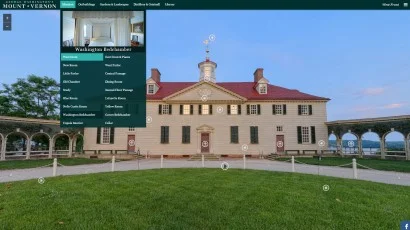
Mount Vernon Virtual Tour
You can explore historic Mount Vernon from your home or classroom. Our new Virtual Tour includes 360-degree panoramic images and clickable points of interest.
Mansion
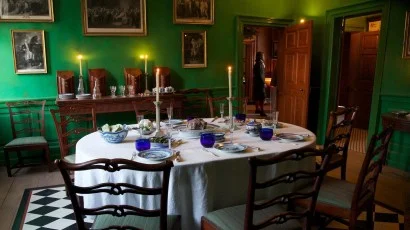
Furnishing Mount Vernon
After inheriting a nearly empty home, the Mount Vernon Ladies' Association faced the tall task of recreating the Mansion's interior—room by room.
4. The expansions of the Mansion have preserved priceless information about the history of the structure and informed its preservation.
The south and north additions to the Mansion were built right up against the outside of the 1758 house. Portions of the 1758 siding were never removed and they are still visible in some of the hard-to-reach crawlspaces in the house.
In these spaces, the earlier rusticated siding has been protected for over 260 years, as well as evidence for second-floor doors that led to porches on top of the one-story “closets” that were removed in the 1770s. The piazza roof covers a section of surviving shingles on the east slope of the 1770s roof.
Since the piazza roof was built just a year after the New Room addition roof was installed, the preserved shingles are brand new and still have their original red paint!
5. The cupola is topped with a weathervane in the shape of a dove of peace.
George Washington commissioned a weathervane for the Mansion’s new cupola while he was presiding over the Constitutional Convention in Philadelphia in 1787. In his order to Philadelphia architect Joseph Rakestraw, Washington specified that the weathervane should
have a bird…with an olive branch in its Mouth…that it will traverse with the wind and therefore may receive the real shape of a bird.
Rakestraw constructed the weathervane from copper with an iron frame and lead head. Unfortunately, because of the increased air pollution around the Washington, D.C. area, the original dove of peace had to be permanently removed in 1993. Today an exact replica rests in its place, and the original can be viewed in Mount Vernon’s Donald W. Reynolds Museum and Education Center.
6. The exterior of the Mansion is rusticated to look like stone - but it is actually made of yellow pine siding.
At Mount Vernon, rustication is a technique designed to shape wooden siding to appear to be stone. This is done first by notching the faces and beveling the edges of weatherboards to give them the appearance of cut stone blocks. Next, the siding is painted with oil paint and sand is thrown onto the wet paint, creating a rough, stone-like texture.
Washington rusticated the Mansion in 1758 to make it appear constructed of structural sandstone blocks, which were more expensive than wood or brick. In doing so, Washington preserved the house his father built, while making it appear in the same league with other more substantially-built—and expensive—houses.

View of the cupola with its iconic dove of peace weathervane (MVLA)

Sand Casting the Mansion
Learn more about the techniques used to paint and cover the exterior of George Washington's Mount Vernon home.
Watch the video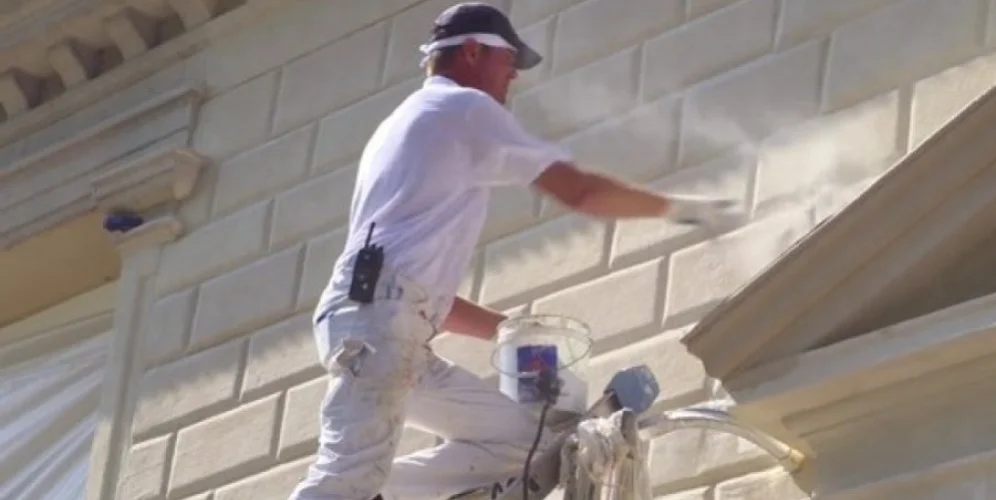
7. The piazza is one of George Washington's contributions to colonial Virginian architecture.
The two-story porch facing the Potomac River is one of the Mansion’s most iconic architectural features and was designed by Washington. In the 18th century, it was extremely rare to see such a grand façade on a private residence.
Washington’s design for the two-story piers copies the pilasters on the exterior of the New Room’s Venetian window, although at a much greater ratio of width to height. The piazza provided an additional living space and is widely copied on homes throughout America.
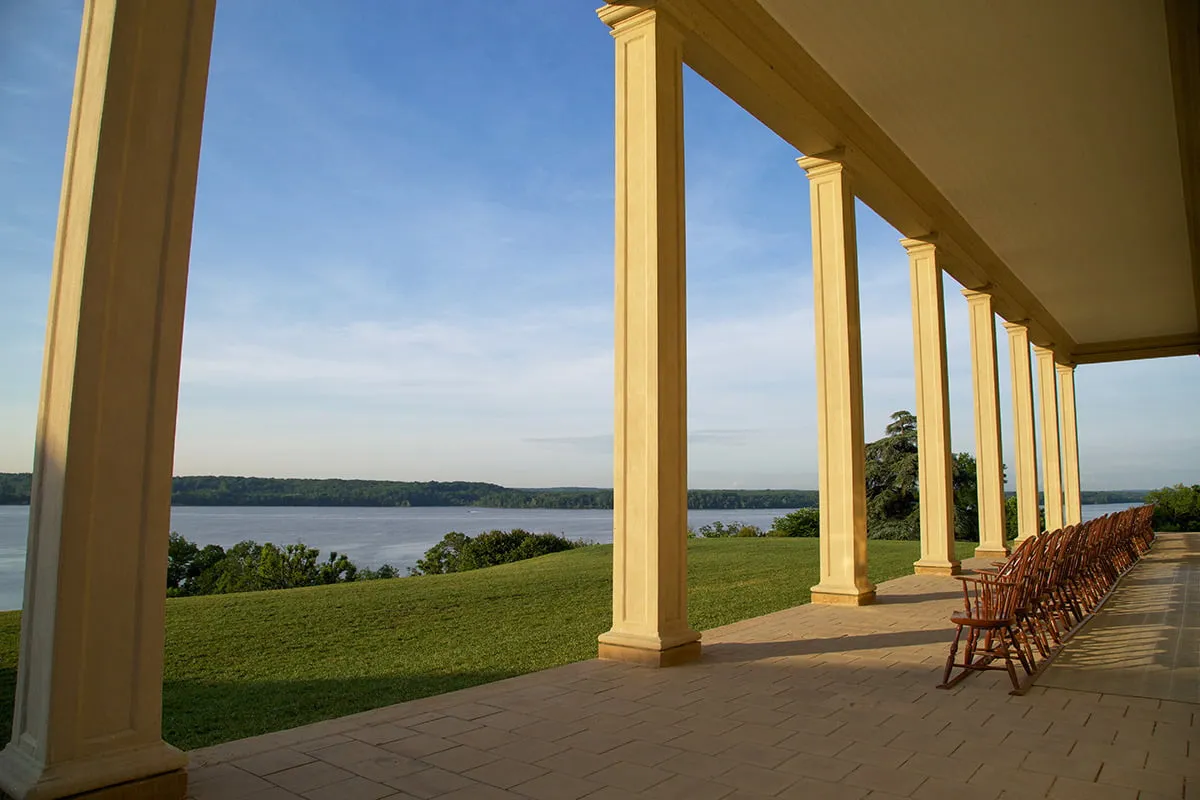
The Mount Vernon Mansion
Photos of George and Martha Washington's home on the Potomac


8. Mount Vernon has a full basement, but there are no secret passages leading from it.
The Mansion basement or cellar was an extremely important part of life in the Mansion. A large room at the south end of the building was designated as the “Cellar Kitchen” on a plan prepared by George Washington in 1774. This space appears to have been used primarily to prepare and serve meals for the Washingtons’ hired white staff and their spouses.
On the plan, three smaller spaces are shown subdividing the room on the west side. These rooms are not extant, but structural evidence indicates that they were constructed, along with a staircase which connected the basement to a landing adjacent to George Washington’s Study on the floor above. Based upon documentary and physical evidence, the rooms likely served as quarters for Frank Lee (an enslaved butler) as well as his wife Lucy (an enslaved cook) and their children.
Along a north-south passage stemming from the Cellar Kitchen, the cellar also contained several storage rooms on either side of the passage for wet and dry storage. Additionally, a 22-foot-deep, brick-lined dry well is set into the floor at the north end; it was initially constructed to store ice, but it never functioned properly for that purpose.

The long passage through the cellar
9. The Washingtons hosted as many as 677 guests at the Mansion in 1798.
The Washingtons had many visitors at Mount Vernon, particularly after the Revolutionary War, as Washington’s political stature grew. Many of these visitors were close friends, family members, or neighbors, but others were unknown to the Washingtons. In 1797, Washington commented about a recent dinner “at which I rarely miss seeing strange faces; come, as they say, out of respect to me. Pray, would not the word curiosity answer as well?”
The steady pace of visitors continued after George Washington’s death in 1799. Martha Washington subsequently moved out of their shared bedchamber to a small room on the third floor. This room afforded her some privacy from the steady stream of visitors who continued to travel to Mount Vernon.
10. The Mount Vernon Ladies' Association bought the Mansion and about 200 acres for $200k in 1858.
Initially writing under the nom de plume, "A Southern Matron," Ann Pamela Cunningham challenged first the women of the South, and later the women of the entire country, to save the home of George Washington from dilapidation.
After convincing John Augustine Washington III to sell the property, Cunningham and the organization she founded, the Mount Vernon Ladies' Association of the Union, raised $200,000 to purchase the mansion and two hundred acres. The Mount Vernon Ladies' Association took over operation of the estate in 1860.
Learn More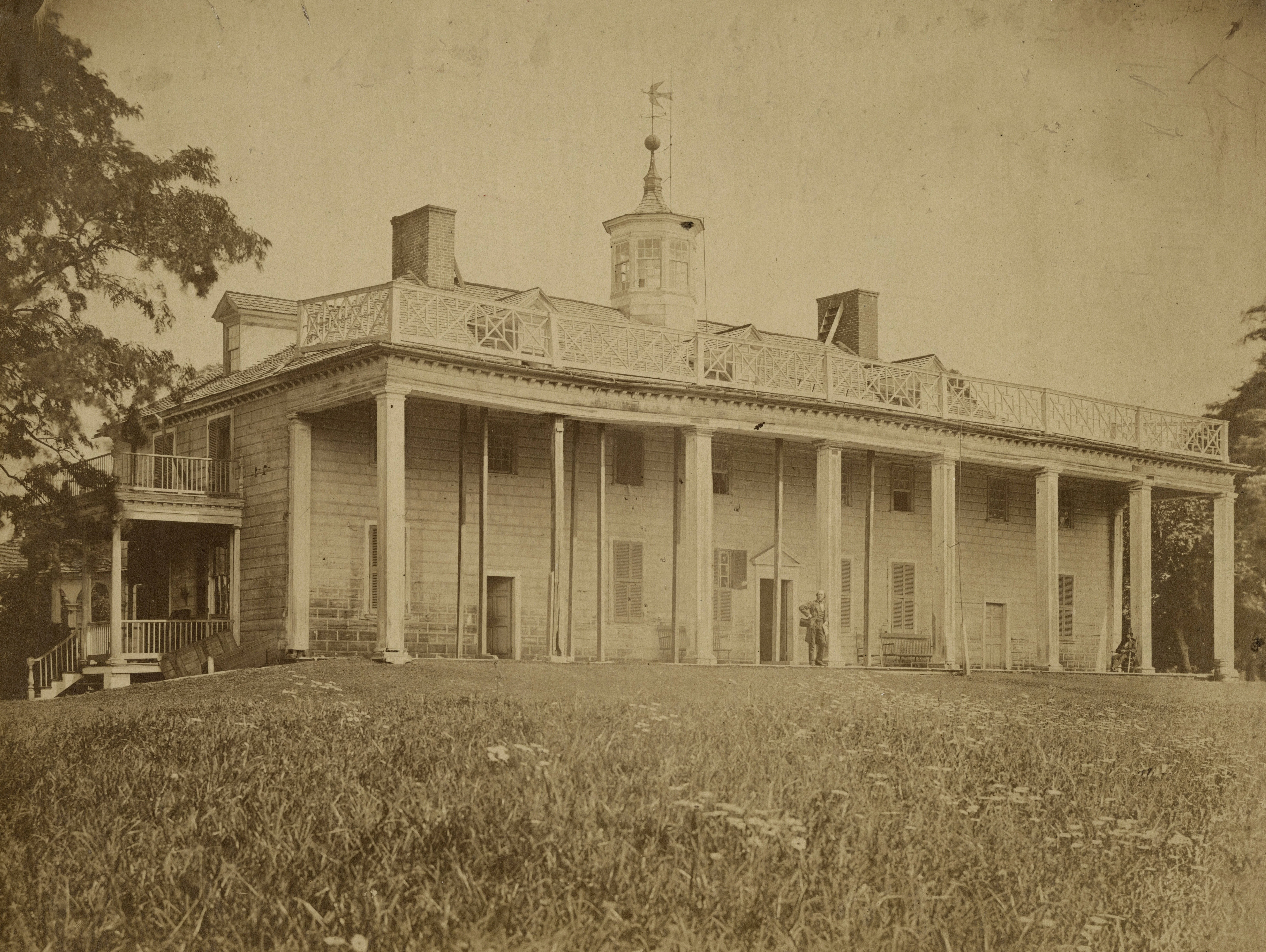
This view of the east front of the Mansion shows wooden posts supporting the sagging piazza and the overall dilapidated state of the structure. Photograph by Lewis E. Walker (possibly), June 1859. (MVLA)
Preservation at Mount Vernon
For more than 160 years the Mount Vernon Ladies' Association has worked to preserve, restore, and manage the estate of George Washington. The effort continues today.
Learn more