
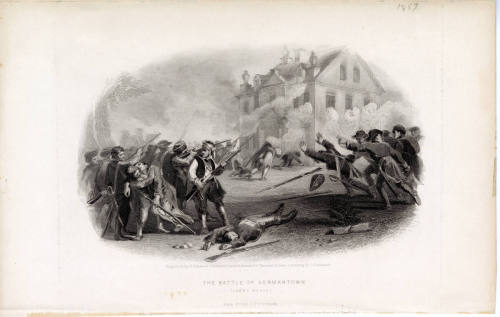
Following defeats at Brandywine, Paoli, and the British capture of Philadelphia on September 26, 1777, George Washington attempted to gain the initiative. He received that opportunity a week later when British General William Howe divided his army. Howe encamped at Germantown, Pennsylvania, seven miles northwest of Philadelphia, with 9,000 men, while other troops garrisoned the city and moved against American forts obstructing the Delaware River. Washington reinforced to 11,000 troops and decided to attack using a plan similar to the one that he employed at the Battle of Trenton in December 1776. However, the Americans experienced challenges coordinating their forces due to foggy weather. After an accidental cross-fire, Americans lost their momentum and the attack resulted in a British victory.
Staging the Battle of Germantown
On the night of October 3, four converging American columns began a sixteen-mile march towards Germantown at “six OClock” as detailed by George Washington in General Orders detailing plans for the attack.1 Generals John Sullivan and Nathanael Greene On the night of October 3, four converging American columns began a sixteen-mile march towards Germantown. Generals John Sullivan and Nathanael Greene would strike Howe's left and right center, respectively, with Continental troops, while two militia detachments attacked both flanks. Although Howe received some intelligence of an impending attack, he did little to prepare for the advance.
The Battle of Germantown
Around 5:30 in the morning, Sullivan's troops surprised Howe's advanced guard and forced it back towards Germantown in confusion as a dense fog blanketed the battlefield. Approximately 100 British soldiers took refuge in Cliveden, a large stone mansion, while the British withdrew. Sullivan wisely bypassed the structure and continued his advance over a mile, driving the British from a series of fenced yards in the town. Greene, delayed on the long march, opened his attack about an hour later and captured part of the British camp in heavy fighting. Although victory seeming, the American attack unraveled.
Sullivan's troops were running low on ammunition and slowed their advance before coming under a volley of friendly fire from Greene's men under the command of General Adam Stephen, who had become disoriented in the fog. Washington lamented the unfortunate weather, as he reflected, “an unfortunate fog, joined with the smoke, prevented the different brigades seeing and supporting each other, or sometimes even distinguishing their fire from the enemy’s.”2 In addition, the militia columns failed to envelop Howe's flanks successfully. On the far right flank, John Armstrong's Pennsylvanians held a Hessian detachment in place but did little more to facilitate an advance. On the opposite end of the field 1,500 New Jersey and Maryland militiamen arrived too late to participate in any major fighting.

The Americans' most serious challenge was at Cliveden. Washington, on the advice of artillery commander Henry Knox, decided to attack the sturdy building rather than isolate it with a small force. For two hours a Continental brigade supported by cannons unsuccessfully tried to storm the mansion, suffering heavy losses. This action diverted troops from Sullivan's main advance and also from Greene's, as some of his soldiers joined the assault.
Other American troops retreated when they heard the heavy firing towards the rear, fearing that they were encircled. Such distractions allowed Howe time to organize a counterattack with fresh troops. The British recaptured their camp and then drove the weary Americans back to their original positions, relieving the men holed up in Cliveden. Reinforced from Philadelphia, Howe pursued Washington for nearly eight miles before halting.
Results of the Battle of Germantown
During the grinding five-hour battle, Washington's casualties numbered 152 killed, with over 500 men wounded, and approximately men 400 captured. Howe's losses included 70 killed and 451 wounded. Finding refuge at Cliveden had spared them such heavy losses. Still, the British were greatly surprised that an opponent whom they believed was beaten could launch such a fierce and sophisticated attack only thwarted by circumstance. Washington recognized the efforts of his forces, writing, “This they will remember, and assure themselves that on the next occasion, by a proper exertion of the powers which God has given them, and inspired by the cause of freedom in which they are engaged, they will be victorious.”3 Despite defeat, these sentiments encouraged morale across the Continental Army.
Michael P. Gabriel, Ph.D. Kutztown University, Revised by Zoie Horecny, Ph.D., 15 May 2026
Notes:
1. “General Orders for Attacking Germantown, 3 October 1777,” Founders Online, National Archives.
2. “General Orders, 5 October 1777,” Founders Online, National Archives.
3. “General Orders, 5 October 1777,” Founders Online, National Archives.
Bibliography:
McGuire, Thomas J. The Philadelphia Campaign: Germantown and the Roads to Valley Forge. Mechanicsburg, PA: Stackpole Books, 2007.
Niderost, Eric. "Victory Denied by the Fog of War." Military Heritage 6 (February 2005): 46-55.
Taffe, Stephen R. The Philadelphia Campaign, 1777-1778. Lawrence: The University Press of Kansas, 2003.
Ward, Christopher. The War of the Revolution, 2 Vols. New York: The Macmillan Co., 1952.

Battle of Germantown
4 October 1777
Commanders:
American: George Washington
British: William Howe
Strength:
American: 11,000
British: 9,000
Result: British Victory
American Casualties:
Killed: 152
Wounded: 521
Captured: 438
British Casualties:
Killed: 71
Wounded: 448
Missing: 14
Digital Encyclopedia
Battle of Brandywine
The Battle of Brandywine, fought just outside of Philadelphia on September 11, 1777, resulted in an overarching British victory and the conquest of the rebel seat of government. However, the victory provided few strategic gains for the British and the valiant effort of the Continental Army proved that the rebels could take on the full brunt of the British Army and survive, bolstering their confidence to fight another day.