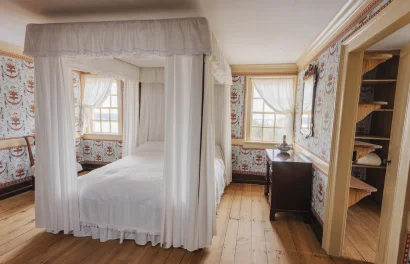
The room known as the Washingtons’ Bedchamber was George and Martha Washington’s private bedroom from the mid-1770s until George Washington’s death in 1799. It was constructed as part of the addition of the south wing of the house that was completed in the winter of 1775-1776. This project coincided with George Washington’s broader plans to develop Mount Vernon. Although a personal retreat for the couple, the room was Martha Washington’s primary workspace during the day. Those enslaved at the Mansion House, such as Caroline Branham and Ona Judge, labored in the room, completing tasks related to its upkeep and domestic needs of the family and the broader estate.1
The Washingtons and The Washingtons’ Bedchamber
In 1774, George Washington began the construction of a private wing of the Mansion on its south end.2 This two-story expansion was meant to give additional living space to the Washingtons and to increase privacy as well. The Washingtons’ Bedchamber included a large closet and store room, and it was connected to the rest of the house through the construction of the nearby Little Passage and Back Stairway. Mrs. Washington’s Store Room featured shelving for items such as linens and cloth to distribute to enslaved laborers. Mrs. Washington’s Closet was a space for her private belongings such as personal clothing, needlework, a French bidet, and valuables such as silver.
The Washingtons’ Bedchamber was completed sometime in the winter of 1775-1776 while Martha was at Washington’s headquarters in Cambridge, Massachusetts. When she returned in 1776, she likely began moving into the space from the Old Chamber on the first floor they had previously used as their bedchamber. Throughout the war years, from 1775-1783, she split her time between Mount Vernon and Washington’s winter headquarters.3 After George Washington returned from the war in 1783, the couple began to share the space full-time until Washington assumed the presidency.
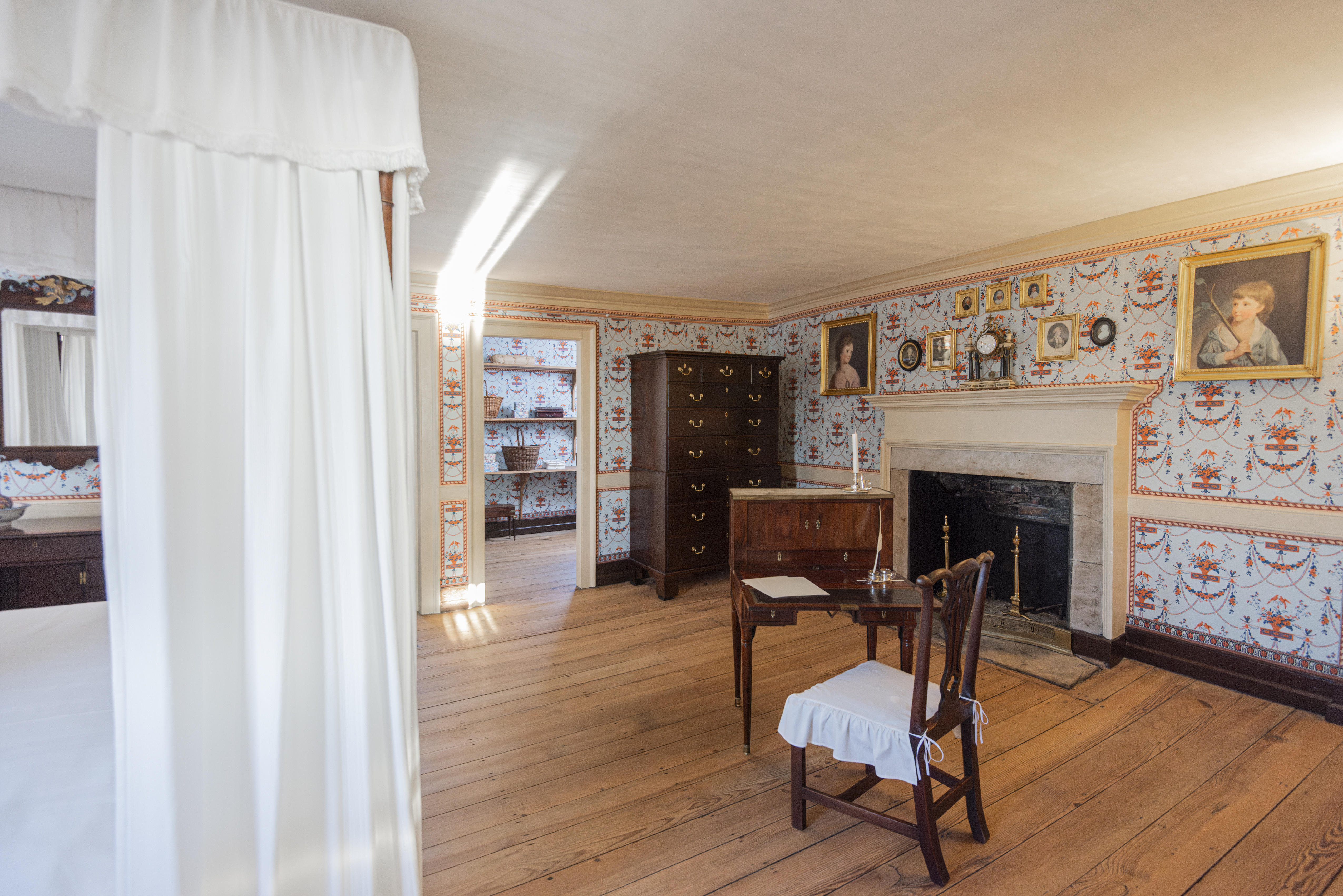
During this time period, the couple used a selection of furnishings they had acquired from England and in America, including an English chest on chest purchased from the Belvoir estate in 1774 and a Virginia-made dressing table from the Custis estate.4 In late 1783, their two youngest grandchildren, Eleanor Parke Custis and George Washington Parke Custis, moved to Mount Vernon. They likely spent a great deal of time with their grandmother, learning and playing in the room.
During George Washington’s presidency (1789-1797), the family spent much of their time in executive residences in New York and Philadelphia. When they returned to Mount Vernon, the Washingtons began to update the space for retirement. In 1796, George Washington requested room measurements to purchase new wallpaper, which was installed the following spring through fall.5 The couple also added new furnishings accumulated during Washington’s presidency. On December 14, 1799, George Washington died in the bed in the room, transforming the room into a site of mourning.6 Shortly thereafter, Martha moved into a garret bedchamber on the third floor for the remainder of her life.7
Notable Artwork
Martha Washington filled the Washingtons’ Bedchamber with portraits of family and friends. Anchoring the installation were a set of four bust-length portraits of her grandchildren (Eliza Parke Custis, Martha Parke Custis, Eleanor Parke Custis, and George Washington Parke Custis) that she commissioned Robert Edge Pine to paint in 1785. A selection of smaller works filled the remainder of the wall space, including a set of oil on board miniatures of George Washington, Martha Washington, and Eleanor Parke Custis, painted by John Trumbull in the 1790s.8 To these she added artworks gifted to her from close friends and well-wishers from abroad: a glass paste medallion of the Earl of Buchan by James Tassie, an engraving of the Countess of Huntington by Robert Bowyer, and a stipple engraving of General Henry Knox by Edward Savage.9
Notable Furnishings
While living in Philadelphia as the first lady, Martha Washington purchased a new mahogany bedstead for their bedchamber at Mount Vernon. The bedstead featured curtains of a fashionable striped woven fabric referred to as dimity.10
The mahogany bonheur de jour or writing desk was purchased in New York in 1790. Previously, it had belonged to the French writer and artist, the Marquise de Bréhan. Martha used it for her own personal correspondence and note taking, and stored the letters from her husband in its compartments. Finished on all sides and relatively lightweight, the piece was designed to be moved wherever was most convenient for Martha to write during a particular day or season. A French clock, also acquired when the Washingtons were in New York City, was placed on the mantel when they returned to Mount Vernon. Inside the firebox of the chimney is a cast iron fireback with the initials “GW” above the Washington family crest that was added in 1787.
Several older pieces of furniture continued in use in the room: the mahogany bureau dressing table made in 1754 for her and her first husband Daniel Parke Custis and a large mahogany chest on chest purchased by the Washingtons in 1774 from the Fairfax estate sale.
Restoration of the Washingtons’ Bedchamber
After Martha Washington’s death in 1802, the furnishings of Mount Vernon were dispersed through bequest and sale. When Mount Vernon was purchased by the Mount Vernon Ladies’ Association, the Mansion was largely empty. One 1865 newspaper reported that the room “contains only a bare and cheap old bedstead, a facsimile of the original.”11 As visitors arriving at Mount Vernon often wanted to see the room in which Washington died, the Association was “very anxious… to put General Washington’s room in perfect order.”12
To further progress, the refurnishing of each of the Mansion rooms was sponsored by a vice-regent of the Association. The furnishing of the Washingtons’ Bedchamber was under the direction of the Vice-Regent for Virginia, and the room was furnished with period and contemporary furniture as well as some original pieces. After George Washington’s death, the original bedstead owned by the Washingtons had passed to Martha’s grandson, George Washington Parke Custis, who displayed it at his home, Arlington House. It was loaned to Mount Vernon in 1877 and formally given to the Mount Vernon Ladies’ Association in 1908. Since that time, the room has undergone several periods of refurnishing.13
In addition to periodic refurnishing as original objects came back and new information came to light, there were several periods of architectural restoration during the 19th and 20th centuries. These were designed to address plaster and wallpaper damage as well as reverse alterations associated with a 19th-century porch addition, with the most extensive restoration occurring in 1949.
By 2025, over 75 years since the 1949 restoration, the space was again in need of attention. One of the key physical tasks of the 2025 restoration was the complete re-plastering of the walls and ceilings, using period appropriate materials and techniques, which allowed unprecedented access to the surviving 18th-century framing that formed the footprint of the rooms. This restoration revealed areas of early plaster and evidence of early wallpaper and paint schemes. Finish analysis of the woodwork revealed the series of finishes over the life of the room, ranging from the gray paint that was applied when the room was first constructed to the fashionable cream color of the late-1790s. The restoration also uncovered further evidence for the arrangement of the shelves in Mrs. Washington’s Closet and Store Room. A fully-intact, 18th-century fork was discovered in the wall cavity of the closet, corroborating the understanding that the closet was used to store silver and expensive utensils.
A reproduction of c. 1795 arabesque-pattern wallpaper and its accompanying borders were also added to the Washingtons’ Bedchamber, reflective of updates made to the room by the Washington family in 1797. No evidence survived of the original paper used in the room in the 1790s, so a period pattern was chosen with a known history of use in an elite American home from a French firm that was patronized by the Washingtons. The c. 1795 paper was found in the Emerson Homestead of York, Maine and is now in the collections of the York Historical Society.
The current configuration of the furniture in the Washingtons’ Bedchamber largely follows John Gadsby Chapman’s painting of the room completed in 1835.14 Chapman consulted with Martha’s grandchildren to reconstruct the space, and featured key furnishings from each of their collections.
Updated by the Center for Digital History, 18 February 2026
Notes:
1. “[Diary entry: 18 February 1786],” Founders Online, National Archives; “James Anderson to George Washington, 14 February 1797,” Founders Online, National Archives.
2. “Lund Washington to George Washington, 10 December 1775,” Founders Online, National Archives.
3. “Traveling Expenses of Martha Washington, 1 July 1783,” Founders Online, National Archives.
4. “[Diary entry: 15 August 1774],” Founders Online, National Archives.
5. “George Washington to William Pearce, 20 November 1796,” Founders Online, National Archives.
6. “II, 14 December 1799,” Founders Online, National Archives.
7. Carol Borchert Cadou, “Celebrating Mrs. Washington: The Restoration of Martha Washington’s Garret Bedchamber.” The Annual Report of the Mount Vernon Ladies’ Association of the Union, 2005: 18.
8. Harriott Pinckney Horry, “1793 Journal, 16 June 1793,” in The Papers of Eliza Lucas Pinckney and Harriott Pinckney Horry Digital Edition, ed. Constance Schulz. Charlottesville: University of Virginia Press, Rotunda, 2012. (accessed 2025-12-09); Martha Washington to Harriott Pinckney Horry, 14 June 1793, The Papers of Martha Washington, ed. Jennifer Stertzer, University of Virginia Press, 2022.
9. “George Washington to Robert Bowyer, 8 January 1792,” Founders Online, National Archives; Edward Savage to Henry Knox, 22 January 1792, Henry Knox Papers, GLC02437.05295, GilderLehrman Institute of American History, New York, New York.
10. A. Hepplewhite and Co., The Cabinet-maker and Upholsterer’s Guide . . . 3rd edition, Improved (London: I. and J. Taylor, 1794), 18.
11. “Evening Post, October 23, 1865,” Mount Vernon Ladies’ Association Archives, Mount Vernon, Virginia.
12. “Sarah Tracy to Ann Pamela Cunningham, March 26, 1861,” Mount Vernon Ladies’ Association Archives, Mount Vernon, Virginia.
13. Matthew John Mosca. “The House and Its Restoration.” Antiques: Mount Vernon, 485.
14. John Gadsby Chapman, Paintings Book, Private Collection.
Bibliography:
Cadou, Carol Borchert. “Celebrating Mrs. Washington: The Restoration of Martha Washington’s Garret Bedchamber.” The Annual Report of the Mount Vernon Ladies’ Association of the Union, 2005.
Fraser, Flora. The Washingtons: George and Martha Partners in Friendship and Love. Anchor Books, 2015.
Garrett, Wendell. ed., George Washington’s Mount Vernon, New York: The Monacelli Press, Inc., 1998.Mosca, Matthew John. “The House and Its Restoration.” Antiques: Mount Vernon, February 1989:
The Papers of Martha Washington, ed. Jennifer Stertzer, University of Virginia Press, 2022.