The Battle of Sullivan’s Island was the first major American victory of the Revolutionary War in South Carolina. The conflict took place on June 28, 1776, six days before the Declaration of Independence was signed. The victory at Sullivan’s Island represented colonists’ willingness and ability to resist British forces, inspiring confidence among military leaders, soldiers, and Patriot civilians.1
Sullivan’s Island Before Battle
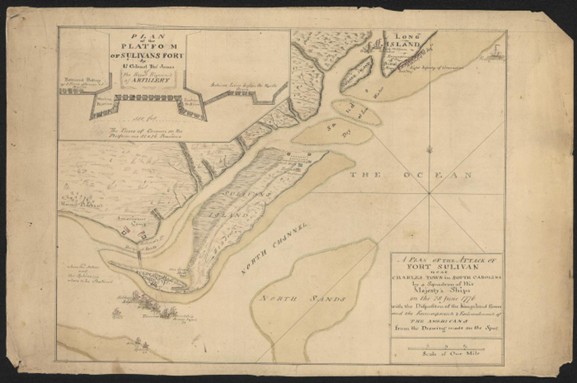
Sullivan’s Island stands at the mouth of Charleston harbor, making it the first point of contact with Carolina by sea. Due to its geographic location, the island played a pivotal role in both the colony’s protection and the local economy as international trade flowed from the island to the mainland. Sullivan’s Island became central to Carolina’s involvement in the international slave trade beginning in the seventeenth century. Records show that enslaved people brought to the colony were quarantined on Sullivan’s Island before traders transported them to Charleston for sale.
As revolutionary ideas of freedom and equality spread in 1775, the island was repurposed as a pathway to freedom. After Lord Dunmore of Virginia issued a proclamation promising freedom to those enslaved by Patriots if they ran away to fight for the British, approximately 500 Black South Carolinians established a community on the island hoping to join the British fleet once it arrived in Charleston harbor. But in December 1775, a colonial ranger company attacked the community, recapturing some and killing others, resulting in only about twenty from the community safely reaching the British fleet. Two months later, Carolina enlisted enslaved laborers to construct a fort on Sullivan’s Island. This fort, constructed with palmetto logs and sand, would be the first structure to greet the British fleet in 1776.
The Arrival of British Forces
The British fleet was outside of Charleston harbor by June 1, 1776. The fleet had traveled to Charleston after evacuating Boston, hoping to capture the valuable southern port. British leadership, including General Henry Clinton, believed that loyalist sentiment was particularly strong in the South, making success at Charleston quite likely.
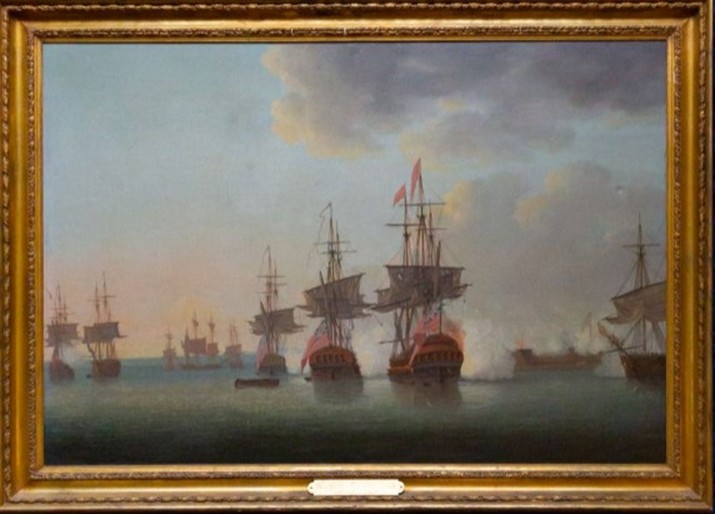
As the British fleet gathered outside Charleston harbor, the American forces led by Major General Charles Lee and Colonel William Moultrie prepared for the impending battle. Lee encouraged Moultrie to abandon Sullivan’s Island and fall back to Charleston where they were better equipped to repel the British. Moultrie refused, choosing instead to stand his ground at the new, partially-constructed fort.
On June 28, the British attacked by land and sea. The currents and shallow waters surrounding the island forced the British fleet to navigate with great precision. General Lee reported that the British dropped their anchors about 400 yards from the island at around eleven in the morning. They bombed the island for ten hours, launching more than 12,000 cannonballs and exploding shells at the fort. The fort withstood the bombardment largely because the natural buoyancy of the palmetto logs helped repel the cannon fire.
In the fort itself, numerous contingents fought to protect Charleston. Colonel Moultrie led members of the 2nd S.C. and 4th S.C. regiments. An additional eighty Catawba fighting men served alongside these soldiers, mostly as riflemen. While Colonel Moultrie seemed to have been confident in his troops’ ability to withstand the British attack, General Lee worried about the “Officers being all Boys, and the Men raw recruits.”2 However, upon traversing the narrow channel to reach Sullivan’s Island, General Lee found that the soldiers stood steadfast in their posts, displaying a “cool courage” which astonished him.
Decisive American Victory
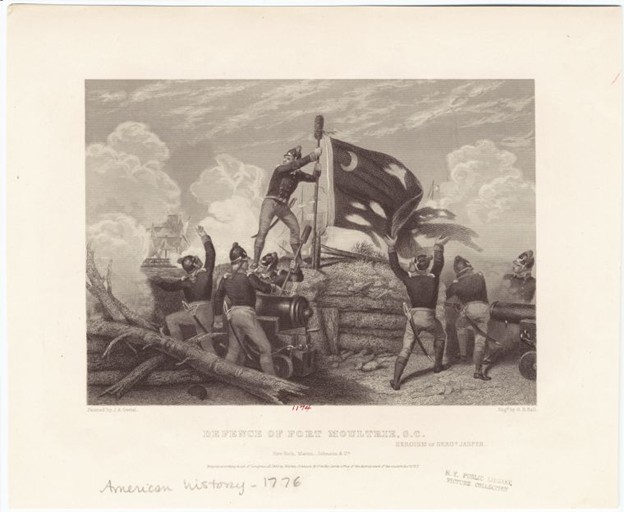
Sergeant William Jasper’s actions would become a well-remembered story of courage at Sullivan’s Island. A British shot had cut the fort’s flagstaff, forcing the flag to fall. Refusing to let the British enjoy such a symbolic win, Jasper retrieved the flag and tied it to a temporary flag staff until the soldiers could erect a more permanent pole. Americans would remember Sergeant Jasper’s act of bravery and his commitment to independence many years later, as seen in artist Johannes Adam Simon Oertel’s painting “Defence of Fort Moultrie, S.C.”
While men like Jasper defended the fort on Sullivan’s Island, Colonel William Thomson of the S.C. Rangers and a group of regulars from North Carolina challenged the British forces attacking by land. General Clinton planned to wade across the channel separating Sullivan’s Island from mainland Carolina. But upon beginning the journey, he and his soldiers found the channel much deeper than their reports had indicated. They then tried to cross using longboats, but Colonel Thomson’s forces forced them to retreat.3
The battle slowed by nightfall with the British ceasing all bombardments around two in the morning. Colonel Moultrie sent a boat to Charleston to share news of the victory. After hearing the news, Susannah Smith Elliott, the wife of Major Barnard Elliott, traveled to Sullivan’s Island by boat to congratulate the soldiers and her husband. Major Elliott recorded that Susannah brought two regimental banners, one red and one blue, to recognize the 2nd S.C. Regiment’s bravery. Upon delivering the banners, Susannah delivered a brief speech, stating that:
“Your Gallant behavior in defense of Liberty & your country intitles you to the highest honors, Accept these two Standards as a reward justly due your Regiment & I make not the least doubt, under Heavens protection, but you will stand by them as long as they can wave in the Air of Liberty.”4
The Aftermath of the Battle of Sullivan’s Island
In the months following the attack, the palmetto tree and Colonel William Moultrie were celebrated for their protection of the fort. South Carolinians created a state seal in July 1776 featuring a palmetto tree in recognition of how palmetto logs protected the fort from British cannon fire. From then onward, South Carolina proudly bore the name of the “palmetto state.” Meanwhile, Carolina named the fort on Sullivan’s Island Fort Moultrie in recognition of Colonel Moultrie’s bravery.5
The British attempted to take Charleston again in 1780, approaching from the south and west to bypass Fort Moultrie entirely. This time, they were successful. The British would occupy the valuable port city for two and half years.6
Gabrielle McCoy, PhD
Notes:
1. “John Page to Thomas Jefferson, 20 July 1776,” Founders Online, National Archives.
2. “Major General Charles Lee to George Washington, 1 July 1776,” Founders Online, National Archives.
3. “Major General Charles Lee to George Washington, 1 July 1776,” Founders Online, National Archives.
4. “4th South Carolina Regiment Order Book,” South Carolina Historical Society Manuscripts, Lowcountry Digital Library, p. 133-34.
5. “May [1791],” Founders Online, National Archives.
6. “Major General Benjamin Lincoln to George Washington, 7 November 1779,” Founders Online, National Archives; “Thomas Digges to John Adams, 28 April 1780,” Founders Online, National Archives.
Bibliography
Bass, Jack and W. Scott Poole, The Palmetto State: The Making of Modern South Carolina. Columbia: University of South Carolina Press, 2009.
Bloom, Cairn. “A Black Loyalist’s Liberty: How Lucy Banbury Took Back Her Freedom.” In Women Waging War in the American Revolution, edited by Holly A. Mayer, 241-60. Charlottesville: University of Virginia Press, 2022.
Buchanan, John. The Road to Guilford Courthouse: The American Revolution in the Carolinas. New York: Wiley, 1997.
Butler, Christina. “British Occupied Charleston, 1780-1782: Diverse Experiences and Daily Life in a Divided City.” SC 250th American Revolution Commission, 2024.
Edgar, Walter B. Partisans and Redcoats: The Southern Conflict that Turned the Tide of the American Revolution. New York: Harper Collins Publishers Inc., William Morrow, 2001.
Heath, Charles L. “Catawba Militarism: Ethnohistorical and Archaeological Overviews.” North Carolina Archaeology 53 (2004): 80-121.
Swan, Philip G. ““The Present Defenceless State of the Country”: Gunpowder Plots in Revolutionary South Carolina.” The South Carolina Historical Magazine 108:4 (Oct. 2007): 297-315.