On May 13, 1787, George Washington arrived in Philadelphia for the Constitutional Convention. For the next three months, Washington presided over the fifty-three delegates as they debated the shape and powers of a new proposed government.1 The Convention enforced a strict code of secrecy to prevent inquisitive Americans from following the contours of the debate. Americans weren’t the only curious observers in Philadelphia, however. The deliberations over the draft Constitution took place within a complicated web of international negotiations.
Don Diego de Gardoqui, the Spanish envoy to the United States, had spent several years in Philadelphia courting American officials on behalf of his government. Americans in the western regions of Pennsylvania, Virginia, North Carolina (including what later became Kentucky, Tennessee, and the Ohio) demanded access to the Mississippi River to transport their goods to market and sell their crops in the bustling port city of New Orleans. Meanwhile, Spain insisted that the American government relinquish their claims to the vital river.
Since his arrival in 1785, Gardoqui had courted Washington as part of his pressure campaign. He sent Washington valuable gifts, including a Spanish donkey named Royal Gift and a bolt of rare South American Vicuna cloth.2 In return, Gardoqui hoped that Washington would use his enormous influence to sway Congress on Spain’s behalf. Washington had gracefully accepted these gifts but proved to be impervious to Spanish influence. When Washington arrived in Philadelphia in May 1787, Gardoqui seized the opportunity to present his case in person and requested a meeting. Washington’s schedule was packed over the summer, but he met with Gardoqui twice in September before returning home to Mount Vernon.3 On the first occasion, they crossed paths at Benjamin Franklin’s house on Franklin Court.
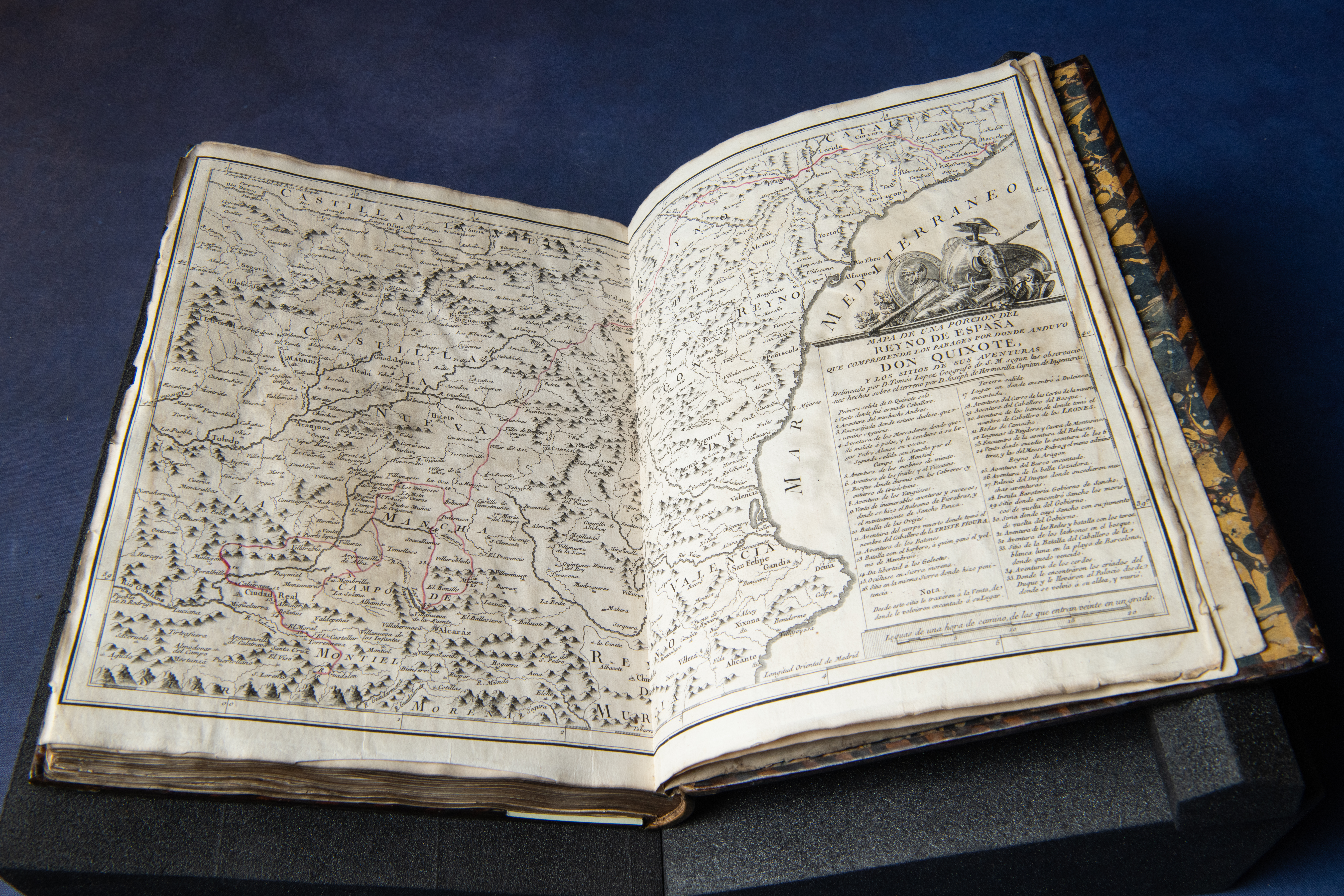
Franklin enjoyed pulling books from his voluminous library and showing off for guests. For esteemed guests like Washington and Gardoqui, he selected some of the finest books he had obtained in Paris, including the four-volume edition of Don Quixote published in Madrid by Joaquin Ibarra. This edition, commissioned by the Real Academia de la Lengua, was printed on distinctive paper, using a new typeface specially designed for it, and was illustrated with handsome copperplate engravings. This edition established Don Quixote as a landmark of Spanish literature. Washington reportedly said he “had never seen it.”4
A week later, Washington wrote in his diary that he “Dined at home in a large Company with Mr. Gardoqui.”5 Perhaps they spoke more that evening about Don Quixote because the book remained on Washington’s mind. On September 17, the Convention completed its work, and the delegates signed the draft. Washington affixed his signature first and enjoyed drinks with the other delegates. Before retiring to his lodgings for the night, Washington visited a local bookseller and purchased a modest four-volume set of Don Quixote in English for 22 shillings and six pence in Pennsylvania currency.6
A few months later, another gift arrived from Gardoqui.7 It was a four-volume set of Don Quixote, the same Spanish edition they had both admired in Franklin’s library. This set was large, filled with beautiful illustrations trimmed in gold leaf. It was bound in rare Russian leather with gold inset detail on the spine, and contained a blue ribbon that was set off the blue and yellow marble endpages. At 300 reales, it cost nearly seven times the amount Washington spent on the English version.
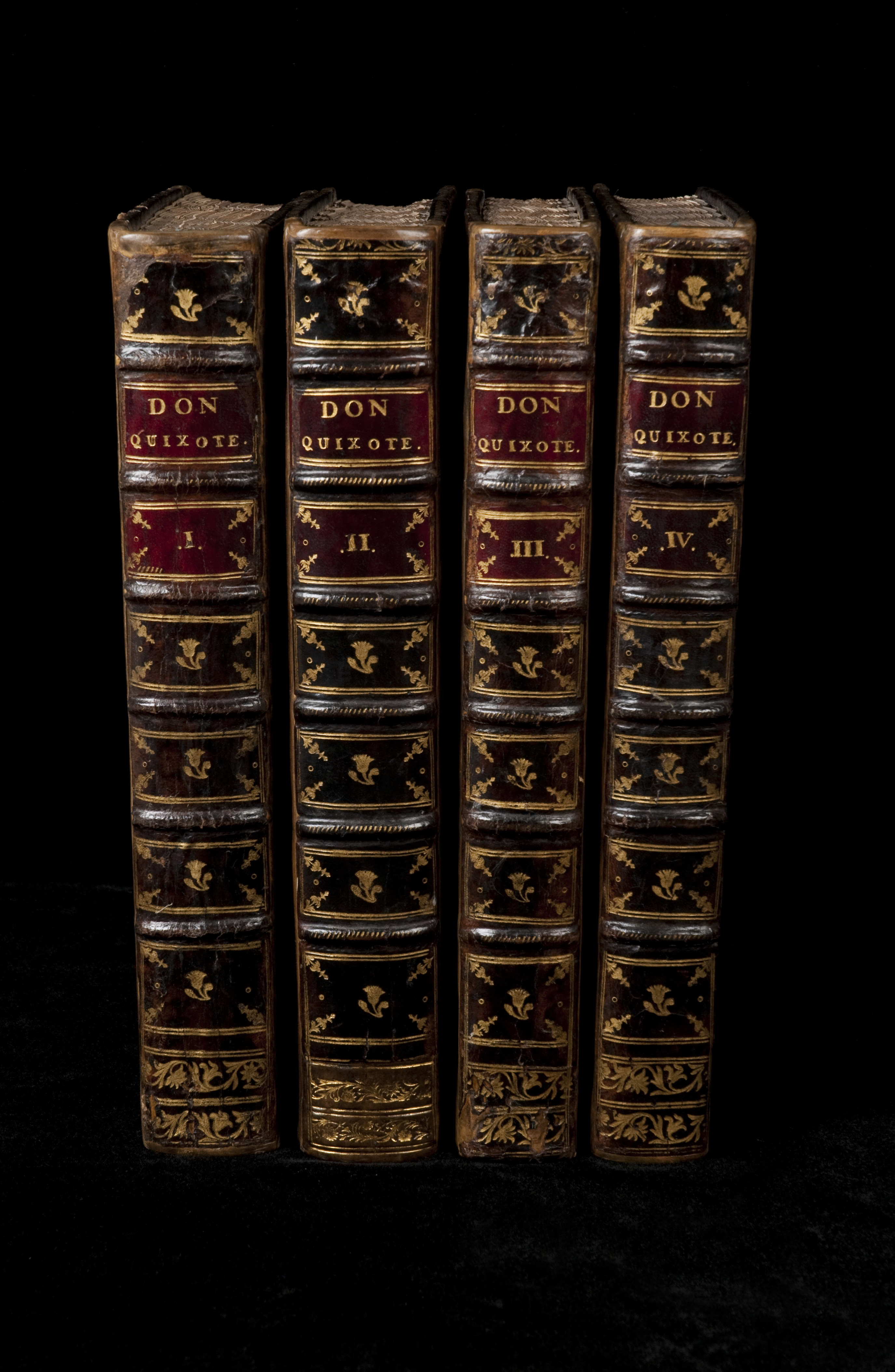
Washington thanked Gardoqui for the “mark of your esteem which is highly pleasing to me, and which merits my warmest acknowledgement.”8 He shared his hope for peace between United States and Spain, but insisted he remained “totally detached from all matters of government,” which therefore prevented him from “interfering, with any degree of propriety, in an affair of this nature.”9
The two sets of the Don Quixote in Washington’s library reveal critical elements of Washington’s personality and leadership. Washington stopped his formal education at age eleven, when his father died. He read voraciously over the course of his lifetime to increase his knowledge and fill in any gaps of this education. His library contains volumes on agriculture, military affairs, political theory, poetry, science, fiction, geography, and antislavery arguments, speaking to the breadth and depth of his learning. Although there had been copies of Don Quixote at Mount Vernon in the past, none of them had been owned by Washington, and he seems not to have read it.10 Washington’s admission that “he had not seen” Don Quixote demonstrated a willingness to admit when he did not know about something—a remarkable admission made in front of two well-respected diplomats. His willingness to acknowledge his own intellectual shortcomings, and then seek out the knowledge by buying the English-language edition, is one example of Washington’s best leadership trait. He knew what he did not know and he surrounded himself with people that made him better and smarter, both as commander-in-chief of the Continental Army and President of the United States.
The Don Quixote volumes also tell a critical story of foreign policy in the Early Republic. They demonstrate that the young United States was actively involved in a vibrant global community from the very beginning, whether exchanging livestock, fine linens, or intellectual pursuits. As the United States struggled to become a powerful nation in its own right, material exchange was inexplicably linked with diplomatic negotiations. The push-and-pull over navigations rights on the Mississippi would remain a central foreign policy issue for the next fifteen years and drove western expansion through the Louisiana Purchase in 1803.
Both sets of Don Quixote remained at Mount Vernon until Washington’s death. In 1983, the English set was gifted to Mount Vernon, and in 2012 the Mount Vernon Ladies Association purchased the Spanish set as part of their efforts to recreate George Washington’s personal library at the George Washington Presidential Library.
Updated by the staff of The George Washington Presidential Library at Mount Vernon, 6 April 2026
Notes:
1. “[Diary entry: 13 May 1787],” Founders Online, National Archives.
2. “[Diary entry: 26 October 1785],” Founders Online, National Archives; “George Washington to Francisco Rendon, 19 December 1785,” Founders Online, National Archives.
3. “[September 1787],” Founders Online, National Archives.
4. “Gardoqui to George Washington, 9 November 1787,” Founders Online, National Archives.
5. “[Diary entry: 11 September 1787],” Founders Online, National Archives.
6. “Philadelphia Cash Accounts, 9 May–22 September 1787,” Founders Online, National Archives.
7. “Gardoqui to George Washington, 9 November 1787,” Founders Online, National Archives.
8. “George Washington to Gardoqui, 28 November 1787,” Founders Online, National Archives.
9. “George Washington to Gardoqui, 28 November 1787,” Founders Online, National Archives.
10. George Washington’s stepson, John Parke Custis, inherited a four volume set of Don Quixote from his father Daniel Parke Custis. Washington compiled an inventory of Daniel Parke Custis’s books after he married Martha that included Don Quixote. (“Appendix D. Inventory of the Books in the Estate, c.1759,” Founders Online, National Archives.) When Martha and her two young children moved to Mount Vernon shortly thereafter, these books were added to Washington’s personal library until John Parke Custis was of age. Washington was careful to notate the proper ownership of each book, and in 1764 he created an updated inventory that also featured this set of Don Quixote. (“List of Books at Mount Vernon, 1764,” Founders Online, National Archives.) Another set of Don Quixote was housed at Mount Vernon before George Washington’s ownership as well. Before his death, Lawrence Washington owned a set of Don Quixote while living at Mount Vernon that was documented in his estate inventory in 1753. Washington, a close companion to his half-brother, was likely aware of Lawrence’s ownership of the popular text.
Bibliography:
Chernow, Ron. Washington: A Life. Penguin Publishing Group, 2010.
Hayes, Kevin J. George Washington: A Life in Books. Oxford University Press, 2017.
Learn More: