John Murray, fourth Earl of Dunmore, was the last British governor of Virginia, appointed to the role in the colonial capital of Williamsburg from 1771 to 1775. Although born a Scottish noble, Lord Dunmore would find himself on the front lines of conflict in the American Revolution and widely detested by the gentry class of colonial Virginia, who he would have previously considered his peers. He is perhaps best known for issuing Dunmore’s Proclamation on November 7, 1775. In this decree, he offered freedom to enslaved people and indentured servants of Virginian patriots if they joined British forces. Several people enslaved by George Washington were among them. Aware of the threat of Dunmore’s Proclamation to the social order of Virginia, Washington wrote of Dunmore, “If the Virginians are wise, that Arch Traitor to the Rights of Humanity, Lord Dunmore, should be instantly crushd, if it takes the force of the whole Colony to do it.”1 However, this call to arms spread throughout the thirteen colonies, prompting enslaved men, women, and children to self-emancipate to British lines throughout the war. Eventually approximately at least twenty thousand Black loyalists fled to the British lines, and after the war upwards of five thousand of the formerly enslaved became refuges throughout the British Empire.
The Months Leading Up to Dunmore’s Proclamation
As one of the wealthiest British colonies, the core of Virginia’s economy was built around its enslaved labor force, which was used to cultivate cash crops and transport them to port cities. A gentry class emerged from those who profited from slavery including founders such as Washington, Thomas Jefferson, and James Madison. In many areas of Virginia enslaved people outnumbered free whites. At his appointment to governor, Dunmore purchased enslaved people to cultivate lands for personal profit. However, he and several other British officials began to fear a predominantly enslaved population was an untenable arrangement for the safety of colonists. But they became even more concerned when Virginia’s elite began to protest the crown’s taxation policies, leveraging their wealth and influence to support the patriot cause. Additionally, Dunmore struggled to communicate with colonial assemblies such as the House of Burgesses as tensions began to mount.2 Dunmore desired to curb their influence and potentially recruit a fighting force to quell rebellion in Virginia.
In April of 1775 Dunmore removed gun powder from the Williamsburg magazine, enraging the Virginia militia and leaders such as Patrick Henry. He began discussing arming enslaved people if violence escalated much to the dismay of white Virginians. In June, Dunmore fled to the British warship the HMS Fowey and ordered raiding parties on the homes of wealthy rebels. At one point it was suspected that he planned to kidnap Martha Washington from Mount Vernon while Washington was away accepting his commission as commander-in-chief.3
After multiple threats to enact martial law, he did so in Dunmore’s Proclamation on November 7, which was made public on November 15. In the decree, he wrote “all indentured Servants, Negroes, or others, (appertaining to Rebels,) free that are able and willing to bear arms” that joined British forces would be freed.4 He defended this action as necessary to “defeat such treasonable purposes” of the patriots, and threatened to confiscate the land and property of rebels.5 This proclamation infuriated revolutionary leaders in Virginia as well as white loyalists. They feared the precedent would spread, disrupting the social and economic order of the south built on enslavement.
Dunmore’s Ethiopian Regiment
On November 14, Dunmore’s force of Black and white loyalists defeated patriots at Kemp’s Landing near Norfolk. His force of Black loyalists became known as the Ethiopian Regiment, numbering nearly eight hundred Black loyalists before it was disbanded. However, the following month Patriot forces occupied Norfolk forcing them to remain on ships until a safer land position could be maintained at Tucker’s Mill Point in early 1776. The regiment faced challenges such as lack of supplies and disease. When their position was again compromised, they fled to Gwynn’s Island in July of 1776. Remaining members well enough to travel then sailed to British occupied New York in August of 1776 to participate in the Battle of Long Island. While Dunmore returned to Britain that November, almost a year after his proclamation, many who self-emancipated to Dunmore’s regiment remained in New York until the end of the war. When he returned to England, he advocated for the financial compensation of displaced loyalists.
The Influence of Dunmore’s Proclamation
Some members of Dunmore’s disbanded Ethiopian Regiment formed a new Black regiment known as the Black Pioneers. As a non-combat unit, the role of the force was to assist in construction related projects. Harry Washington, who was formerly enslaved by George Washington and self-emancipated from Mount Vernon, rose through the ranks of the Black Pioneers. These units of Black loyalists grew in number as the offer of freedom in exchange for supporting the British spurred enslaved men, women, and children to self-emancipate in other colonies. Some, such as Boston King, escaped slavery and travelled through multiple states to reach British forces, risking their lives and punishment if recaptured. The continued support of Black loyalists prompted Sir Henry Clinton to issue the Philipsburg Proclamation in 1779, which extended Dunmore’s Proclamation to all thirteen colonies. While this measure technically expanded the initial offers of emancipation, it did not protect the freedom of those who joined the British. When captured, loyalists and patriots often sold Black loyalists back into slavery.
Leaders in the Continental Army contemplated the enlistment of Black troops for the patriot cause. John Laurens of South Carolina advocated for the enlistment of Black troops. He leveraged his position as an aide de camp of Washington to unsuccessfully propel his support for the recruitment of Black soldiers in South Carolina. However, as the war progressed, Washington authorized the enlistment of African Americans if those who enslaved them manumitted them, authorized their service, and were compensated, such as in the case of the 1st Rhode Island regiment.6 Approximately five thousand African Americans served in various regiments of state militias as well as the Continental Army and Navy. Several thousand enslaved people were impressed for service building roads and fortifications in addition to domestic service for the officer corp.
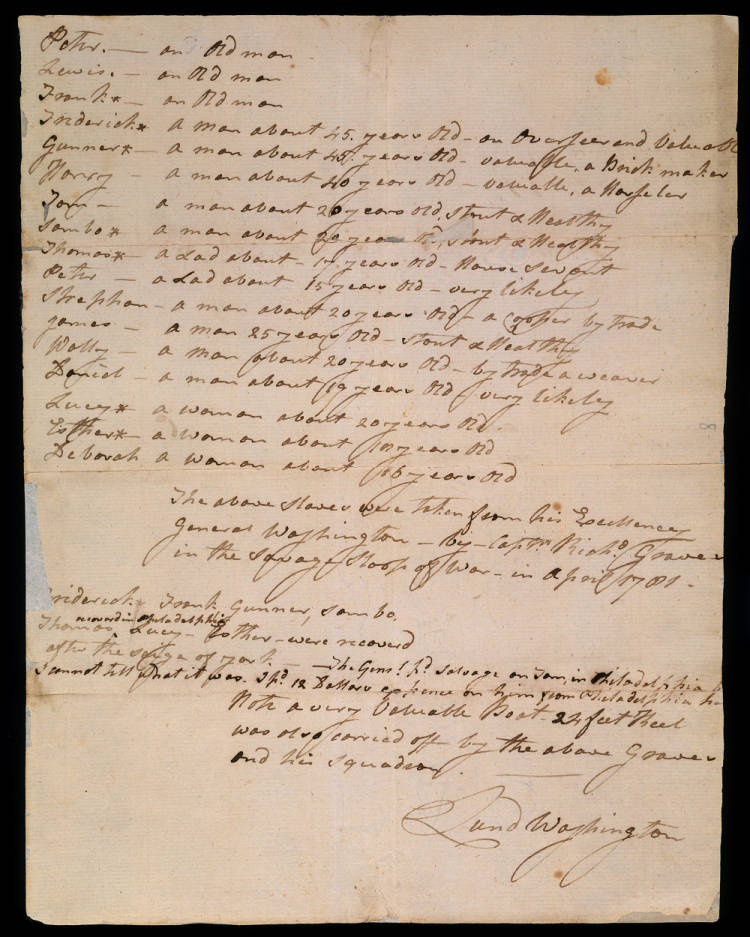
As the war was ending, and the likelihood of British surrender was growing, enslaved people continued to self-emancipate to British lines. In the Spring of 1781, possibly seventeen people enslaved at Mount Vernon escaped to the British warship the H.M.S. Savage.7 Controversially and to Washington’s displeasure, Lund Washington, the Farm Manager of Mount Vernon, boarded the vessel with supplies for the British in an attempt to recapture them.8 Seven of these individuals were returned to Mount Vernon and back into slavery after the Yorktown Campaign later that year. However, some, such as Daniel Payne, maintained their freedom, and later immigrated to British-controlled Nova Scotia.
The Fate of Black Loyalists After the American Revolution
Many freed people who escaped to British lines faced re-enslavement during and after the war, especially those in cities such as Savannah and Charleston. Throughout the war, those who served with the British began to leave cities such as New York and Boston to settle in Nova Scotia, and leaders such as General Sir Guy Carleton encouraged the establishment of Black settlements there. Harry Washington settled in Shelburne, Nova Scotia. Often Black refugees experienced discrimination, being granted less fertile lands than white loyalists and being targeted due to their race. Some were routed to other parts of the British Empire such as East Florida, Jamaica, and the Bahamas often before journeying to Nova Scotia.
The Treaty of Paris formally ended the American Revolution in September of 1783. Article 7 of the treaty emphasized the restoration of property to patriots, including enslaved people.9 Washington desired the return of enslaved people as property unjustly confiscated during the war. He was “surprised[sic]” that British General Sir Guy Carleton did not want to violate the agreements of previous generals offering their freedom in exchange for service.10Instead, Carleton negotiated that the British would provide financial compensation to those who formerly enslaved them. However, this never came into widespread fruition as state and local governments navigated the unrealistic logistics of doing so. But in an effort to comply with the treaty, the British began to take formal account of Black loyalists. Brigadier General Samuel Birch compiled the Book of Negroes to grant freedom certificates, which recorded 3,000 people who had resettled in Nova Scotia. Although not comprehensive, it listed those such as Harry Washington and Daniel Payne. Those listed provided information about their military service (if applicable) and information on who formerly enslaved them. Serving as the governor of the Bahamas, Dunmore created a tribunal to differentiate between Black loyalists with refugee status and those lawfully enslaved by white loyalist refugees in 1787. After protests by Blacks and whites alike, only thirty people appeared before the court with documentation supporting their freedom. Only one man was found lawfully free.
Despite efforts by Washington and the nascent United States to prevent it, Black loyalists continued to emigrate to different parts of the British Empire as refugees as the British evacuated after the war. In doing so they faced challenges such as lack of resources, reduced material support, and for some new, unfamiliar environments. Almost a thousand Black loyalists relocated to England via London, and it is difficult to track their fates as racial designations for people of color included people from the Indian subcontinent. Facing crimes associated to poverty, some were forcibly shipped to New South Wales (Australia) in the years to come. Dealing with similar challenges in Nova Scotia, Black loyalists sought opportunities elsewhere, appealing to Parliament to resettle. A coalition of Black leaders, British abolitionists, investors, and missionaries established a new settlement in Sierra Leone. In January of 1792, 1,200 Black refugees sailed from Halifax to Sierra Leone, including Harry Washington. However, upon arrival, they had varying futures. Many struggled to earn a profitable living in agriculture when discovering they would be charged higher taxes in the new colony than in Nova Scotia. Some were captured and resold into slavery.
The fate of Black loyalists was uneven throughout the British Empire, and protections of their freedom and prosperity were not upheld by the crown in the years following their defeat against the Americans. While many faced challenges that resulted in death or re-enslavement, thousands navigated the Atlantic World in the Age of Revolution. While Dunmore likely did not anticipate the future diaspora of Black freedom seekers across the British Empire when he issued his proclamation in 1775, his call to arms was answered by men, women, and children willing to risk their lives for the chance.
Zoie Horecny, PhD, 3 November 2025
Notes:
1. “George Washington to Lieutenant Colonel Joseph Reed, 15 December 1775,” Founders Online, National Archives.
2. Washington had interacted with Dunmore before the onset of the war while serving in the House of Burgesses. “[Diary entry: 7 March 1773],” Founders Online, National Archives.
3. “George Washington to Lund Washington, 20 August 1775,” Founders Online, National Archives.
4. By his Excellency the Right Honorable John Earl of Dunmore . . . A Proclamation, 1775, Broadside 1775. V852 FF, Special Collections, Library of Virginia.
5. By his Excellency the Right Honorable John Earl of Dunmore . . . A Proclamation, 1775, Broadside 1775. V852 FF, Special Collections, Library of Virginia.
6. “George Washington to Christopher Greene, 27 November 1780,” Box 2, Folder: 1790. Special Collections, The George Washington Presidential Library at Mount Vernon.
7. “Lund Washington, List of Slaves Returned from British, 1781,” Historical Manuscript Collection, The George Washington Presidential Library at Mount Vernon. Seventeen people are listed by Lund Washington in reference to people who fled to the British: Lucy, Ester, Deborah, Peter, Lewis, Frank, Fredrick, Harry Washington, Tom, Sambo, Thomas, Peter, Stephen, James, Wally, Daniel, and Gunner. However, it is known some of the people listed in this list such as Harry Washington and possibly Deborah Squash self-emancipated to the British before the group that fled to the H.M.S. Savage. Also see Mary V. Thompson, “The Only Unavoidable Subject of Regret”: George Washington, Slavery, and the Enslaved Community at Mount Vernon (Charlottesville: University of Virginia Press, 2019) 439.
8. "George Washington to Lund Washington, 30 April 1781," Founders Online, National Archives.
9. Treaty of Paris; 9/3/1783; Perfected Treaties, 1778 - 1945; General Records of the United States Government, Record Group 11; National Archives Building, Washington, DC.
10. “Account of a Conference between Washington and Sir Guy Carleton, 6 May 1783,” Founders Online, National Archives,
Bibliography:
Egerton, Douglas. Death or Liberty: African Americans and Revolutionary America. Oxford University Press, 2009.
Holton, Woody. Forced Founders: Indians, Debtors, Slaves, & the Making of the American Revolution in Virginia. University of North Carolina Press, 1999.
Holton, Woody. Liberty is Sweet: The Hidden History of the American Revolution. Simon & Schuster, 2021.
Iverson, Justin. Rebels in Arms: Black Resistance and the Fight for Freedom in the Anglo-Atlantic. University of George Press, 2022.
Jasanoff, Maya. Liberty’s Exiles: American Loyalists in the Revolutionary War. Alfred A. Knopf, 2012.
Lawler, Andrew. A Perfect Frenzy: A Royal Governor, His Black Allies, and the Crisis that Spurred the American Revolution. Atlantic Monthly Press, 2025.
Quarles, Benjamin. The Negro in the American Revolution. Omohundro Institute and UNC Press, 1961.
Van Buskirk, Judith L. Standing in Their Own Light: African American Patriots in the American Revolution. Norman: University of Oklahoma Press, 2017.