John Glover (1732-1797) was a Continental army officer who served from 1776 until 1782. He emerged from humble beginnings in the town of Marblehead, Massachusetts to become a prosperous merchant and shipmaster. In the early years of the War for Independence, he commanded a regiment of, in George Washington’s words, “Soldiers who have been bred to the Sea.”1 Initially, he joined American forces during the Siege of Boston as a commander of a militia regiment. Quickly, Glover’s leadership proved to be invaluable to George Washington. He joined the Continental Army during the dark days of New York-New Jersey Campaign of 1776. Held in high esteem by Washington, Glover continued as a Brigadier General in the Saratoga Campaign of 1777.
Early Life
John Glover was born in Salem, Massachusetts, on November 5, 1732, the third of Jonathan and Tabitha (neé Bacon) Glover’s four sons. After the premature death of the father in 1737, the family moved to the thriving port of Marblehead.2 At a young age, John helped support his family as a cordwainer in this hardscrabble environment. As he grew into manhood, he opened a tavern and then ventured into the fishing industry of the region with the purchase of a ship. He married, began a family, and cultivated his businesses. As his commerce grew, John Glover’s influence in the community followed and, by 1770, he found himself a principal member of the “codfish aristocracy” of the North Shore of Massachusetts.3
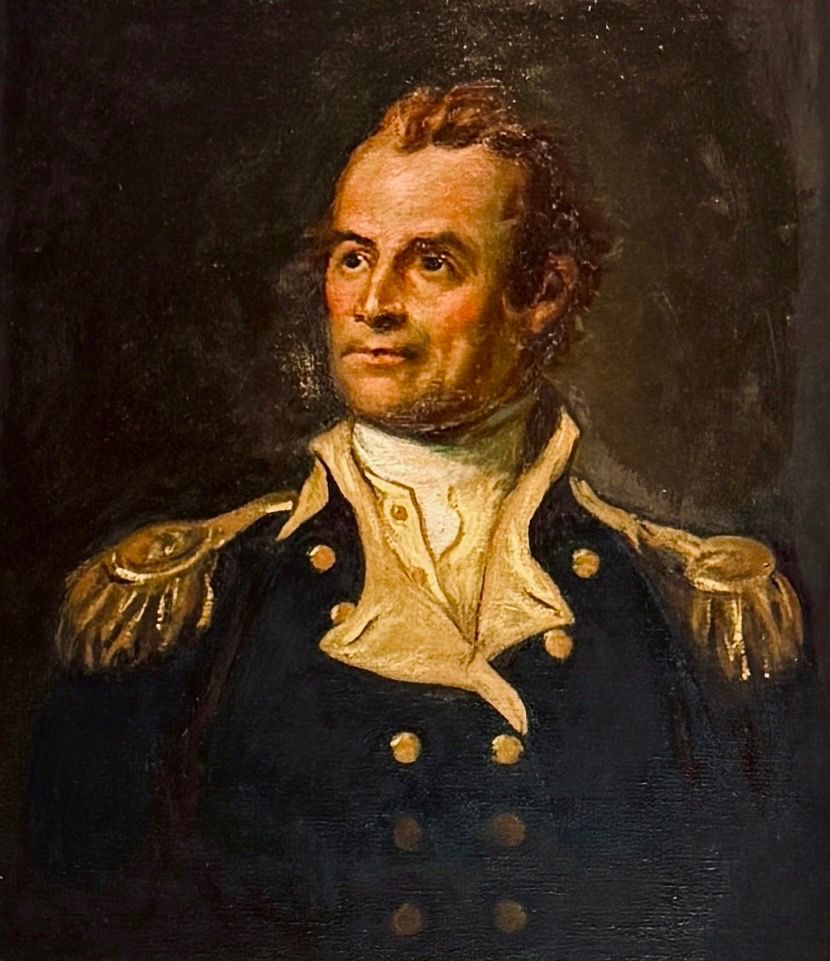
Changes in British taxation policies in the colonies in the aftermath of the Seven Years’ War adversely affected the livelihoods of John Glover’s family and neighbors. As the British ministry applied increasing pressure, many of the people of Massachusetts reacted with organized resistance. John Glover was an integral part of this opposition in Marblehead and was appointed to the local Committee of Correspondence in 1772 and the Committee of Inspection in 1774.4 Having also served continuously as an officer in the town militia since 1759, he progressed to the command of a company of foot by 1773.5 As armed conflict seemed inevitable, Glover was made second-in-command of the Marblehead Regiment, and with the unexpected death of the unit’s commander in early 1775, he was advanced to the unit’s head with the rank of Colonel.6
Service in the American Revolution
Following the Battle at Bunker Hill, Glover marched his regiment to Cambridge, Massachusetts to join the fledgling Continental Army besieging the British Army in Boston. It was here that he first met George Washington. Undoubtedly impressed by the military discipline demonstrated by the Marblehead Regiment, Washington re-designated it as the 14th Continental Regiment when taken into the Continental Army. The unit was further differentiated by having approximately fifty men of African or Indigenous descent in its ranks.7 When General Washington determined to interrupt the enemy in Boston from being supplied by sea, he sought Glover’s counsel and employed one of his schooners for this purpose.8
When the British evacuated Boston in the spring of 1776, the Continental Army reorganized to capture New York City. Glover’s regiment joined the main army in New York, but they were not part of the American forces defeated at the Battle of Long Island. After British General William Howe outflanked the rebels and penned them in on Brooklyn Heights, General Washington called upon John Glover and Israel Hutchinson’s regiments to ferry his army across the East River to Manhattan Island. Aided by fog, Washington’s troops were expertly boated to New York City during the night of August 29–30 without incident.9 The British Army resumed the chase of the Continental Army on Manhattan Island.
On October 18, 1776, a brigade of roughly seven hundred and fifty under Glover’s temporary command stymied the advance of an enemy force five times his number at the Battle of Pell’s Point.10 Ultimately, the British Army pushed Washington’s force out of New York, across New Jersey, and into eastern Pennsylvania. Realizing he would soon lose much of his army to the expiration of enlistments, General Washington planned to make a bold strike on an enemy outpost at Trenton, New Jersey. Glover’s amphibious regiment still referred to as “Marbleheaders” were once again called upon to assist in ferrying Washington’s troops across the ice-choked Delaware River on the night of December 25-26, 1776. Once the force was across, John Glover and his regiment shouldered their muskets and joined the ranks for the victorious attack against the Hessian garrison in the Battle of Trenton.11
The terms of service for the 14th Continental Regiment expired at the end of 1776 and the regiment thereby disbanded. Colonel Glover returned to his home to tend to his family and businesses. However, in February 1777, the Continental Congress resolved to promote Glover to the rank of Brigadier General. He initially declined the appointment, not believing himself capable “of doing the duty, necessary to be don[e] by an officer of that Rank.”12 General Washington coaxed him to reconsider, writing: “without flattery, …I know of no man better qualified than you to conduct a Brigade, You have activity and industry, and as you very well know the duty of a colonel, you know how to exact that duty from others.”13 Glover accepted and was assigned the command of a brigade for the successful Saratoga Campaign in 1777, where the British surrendered almost six-thousand troops to General Horatio Gates. In the summer of 1778, he was a part of the Siege of Rhode Island. He was posted afterwards to the Hudson River highlands. A long bout of illness forced John Glover to retire from the Continental Army, and with General George Washington’s endorsement, Congress accepted Glover’s resignation on July 22, 1782. 14
Later Life
After the war, John Glover returned to Marblehead to rebuild his broken health and his neglected businesses. He served as a selectman for Marblehead for many years, and was a delegate to the state convention to ratify the federal constitution in 1788, where he voted in favor of the document’s passing.15 He also served a single term, from 1788-1790, in the state legislature.16 In the latter office, Glover welcomed President George Washington to Boston during his inaugural tour of New England in the autumn of 1789.17 John Glover died in Marblehead on January 30, 1797, and was remembered in an obituary as “a citizen, whose services during the revolution, will ever render his memory dear to the friends of his country.”18
Samuel K. Fore
Notes:
1. “George Washington to John Augustine Washington, 13 October 1775,” Founders Online, National Archives.
2. Frank A. Gardner, ed. “Birthplace of General John Glover” Massachusetts Magazine V (1912), pp. 37-38.; Vital Records of Salem, Massachusetts to the Year 1849. Vol. I: Births (Salem: Essex Inst., 1916), 359.
3. The Diary of William Bentley D.D., Pastor of the East Church, Salem, Massachusetts. Vol. III: January 1803-December 1810. (Salem, Mass.: The Essex Institute, 1911), 130.
4. Marblehead, Massachusetts Town Records (EC 18), Dec. 8, 1772 & Nov. 7, 1774. Courtesy of Phillips Library, Peabody Essex Museum, Rowley, Mass.
5. [Commission of appointment as Ensign to John Glover by Gov. Thos. Pownall, March 12, 1759],[Commission of appointment as Captain to John Glover by Gov. Thomas Hutchinson, Feb. 8, 1773], and [Commission of appointment as Captain to John Glover by Gov. Thomas Hutchinson, Feb. 8, 1773], Phillips Library Digital Collections, Phillips Library, Peabody Essex Museum, Rowley, Mass.
6. William Lincoln, ed. The Journals of Each Provincial Congress of Massachusetts in 1774 and 1775, and of the Committee of Safety, With an Appendix,... (Boston, Dutton & Wentworth..., 1838), 313-314.
7. Robert K. Wright, Jr. The Continental Army. (Washington, D.C.: Center of Military History…, 1989), 218 & Captain Alexander Graydon, of the 3rd Pennsylvania Regiment, would recall there being “an appearance of discipline in” the Marblehead Regiment. See Alexander Graydon, Memoirs of a Life, Chiefly Passed in Pennsylvania, Within the Last Sixty Years… (Harrisburgh, Penn.: Printed by John Wyeth, 1811), 130-131.
8. “Instructions to Colonel John Glover and Stephen Moylan, 4 October 1775,” Founders Online, National Archives; George Athan Billias, “Outfitting Washington’s Fleet” in General John Glover and His Marblehead Mariners. (New York: Holt, Rhinehart and Winston, 1960.
9. “The Kemble Papers. Vol. I, 1773-1789”, entry for “Friday, August 30th” [1776]. Collections of the New York Historical Society..., XVI (New York: Printed for the Society, 1884), 86.
10. “Lieutenant Colonel Robert Hanson Harrison to John Hancock, 20 October 1776,” Founders Online, National Archives; “General Orders, 21 October 1776,” Founders Online, National Archives.
11. Roads, Samuel. History & Traditions of Marblehead 3d. ed. (Marblehead, [Mass.]: N. A. Lindsey & Co.,1897), p. 177 & David Hackett Fischer Washington’s Crossing. (Oxford & New York: Oxford University Press, 2004), 203.
12. Ford, Worthington C., ed. Journals of the Continental Congress 1774-1789: Vol. VII, 1777. (Washington, D.C.: Government Printing Office, 1907), 140-141.
13. “To George Washington from Brigadier General John Glover, 1 April 1777,” Founders Online, National Archives; “From George Washington to Brigadier General John Glover, 26 April 1777,” Founders Online, National Archives.
14. “To George Washington from John Glover, 4 May 1782,” Founders Online, National Archives; Hunt, Gaillard, ed. Journals of the Continental Congress 1774-1789: Vol. XXII, 1782. (Washington, D.C.: Government Printing Office, 1914), 405.
15. John P. Kaminski, et al, eds. The Documentary History of the Ratification of the Constitution. Vol. VI: Ratification of the Constitution by the States: Massachusetts. (Madison: State Historical Society of Wisconsin, 1997), 1463-1467.
16. George Athan Billias. General John Glover and His Marblehead Mariners. (New York: Holt, Rhinehart & Winston, 1960), 198-199.
17. “To George Washington from John Glover, 24 February 1790,” Founders Online, National Archives.
18. Gazette of the United States & Philadelphia Daily Advertiser, (Philadelphia, Penn.,) February 10, 1797.
Bibliography:
Billias, George A. General John Glover and his Marblehead Mariners. New York: Holt, [1960].
Fischer, David Hackett. Washington’s Crossing. Oxford & New York: Oxford University Press, 2004.
O’Donnell, Patrick K. The Indispensables: The Diverse Soldier-Mariners Who Shaped the Country, Formed the Navy, and Rowed Washington Across the Delaware. New York: Atlantic Monthly Press, 2021.
Upham, William P. A Memoir of General John Glover, of Marblehead. Salem, Mass.: Printed by C. W. Swasey, 1863.