Peter Hardiman (sometimes spelled Hardman) was born around 1759. He spent most of his adult life as an enslaved groom and stud manager at Mount Vernon. As stud manager, Hardiman would have monitored all the animals’ health, managed the mating process, tracked pregnancies, and attended births.
George Washington did not own him outright. Rather, Hardiman was enslaved by John Parke Custis, Martha Washington’s son from her first marriage. In the years after John Parke Custis’ death in 1781, his widow, Eleanor, remarried. Her new husband Dr. David Stuart managed John Parke Custis’ estate, including those enslaved by Custis. It is most likely Hardiman first came to Mount Vernon sometime in 1785 after Washington purchased horses from Custis’ estate.1 However, it appears this hire became more formalized in 1786, as Washington paid for his labor for four years from 1786-1790, and then in increments of one to three years afterwards.2
Long before arriving at Mount Vernon, Hardiman resided at one of the various properties owned by the Custis Estate in New Kent County. In 1771, he appeared to be living at a property called Brick House Plantation.3 Given his young age, he likely lived with immediate or extended family. However, he likely became separated from them when he was moved to Abingdon, a property purchased by John Parke Custis in present-day Arlington County, Virginia, a few years after his marriage to Eleanor Calvert. John Parke Custis’ probate inventory, taken a year after his death, records Peter “Hardyman” at Abingdon. Two work horses and two mares were also located at Abingdon, but over a dozen horses, including named colts and stallions were owned by Custis at various other properties.4
It is more than likely that Hardiman arrived at Mount Vernon already having experience in caring for horses. As a groom, Hardiman would have been responsible for the daily care of George Washington’s horses, donkeys, and mules. This care would have involved feeding and grooming the equids and scheduling veterinary visits when needed. Although being a groom was a skilled position, George Washington believed that the “feeding & dressing can be performed as well by any other person” as Hardiman.5
Hardiman’s true expertise came in his work as Washington’s stud manager. A stud manager oversees the breeding operations on a farm. Washington described Hardiman as “essentially serviceable to me” during the annual mating season of April to August and throughout the foaling season, “the time of the Mares dropping their young.”6
Hardiman was especially involved in the mule breeding operation at Mount Vernon. George Washington believed that the mule, a cross between a male donkey and a female horse, would revolutionize American farming due to the mule’s strength and low-maintenance care. To prove his theory, Washington imported two valuable male donkeys from Spain in 1785 named Royal Gift and Knight of Malta.
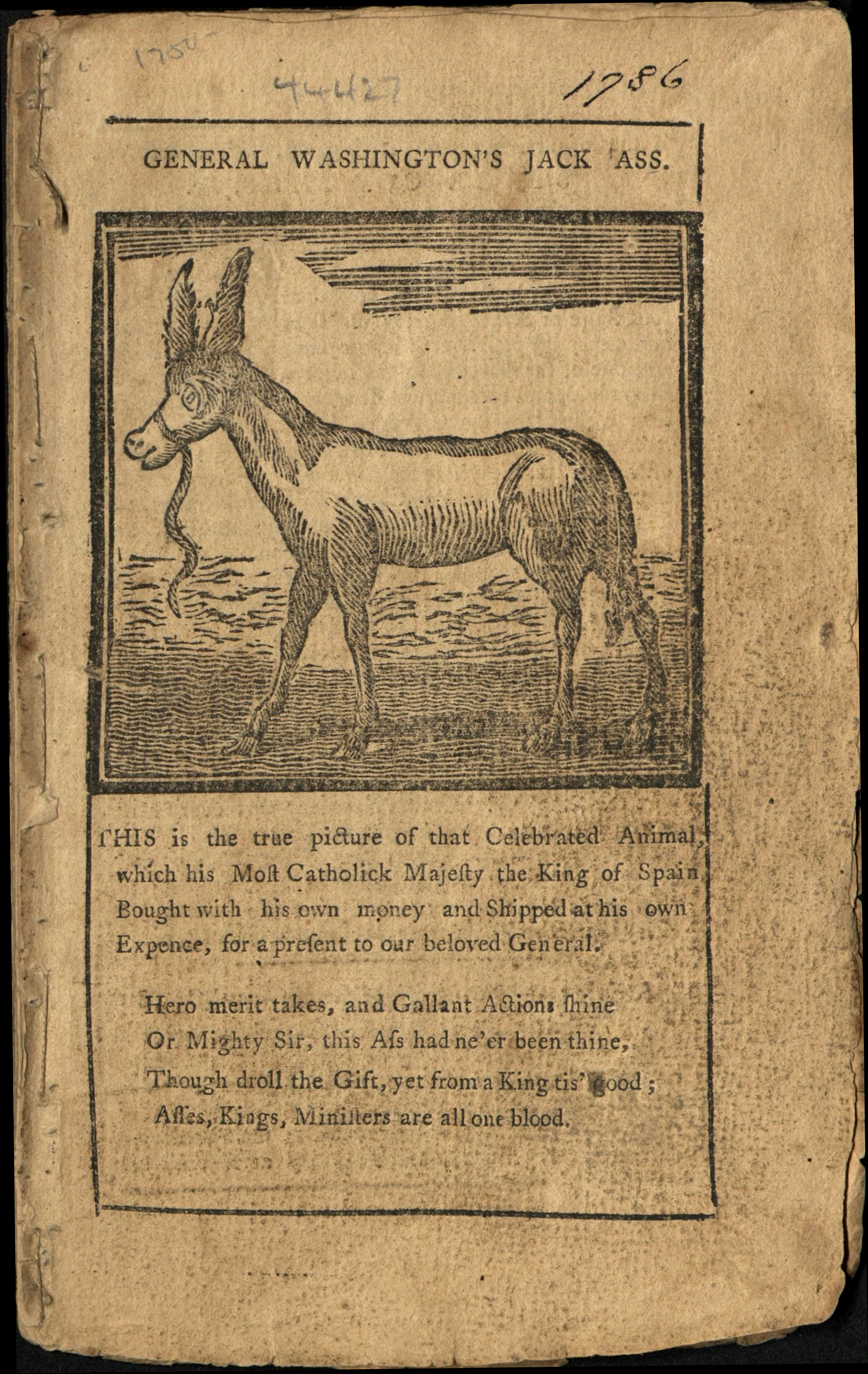
According to farm reports and Washington’s letters, Hardiman managed breeding Royal Gift and Knight of Malta with mares, or female horses. In April 1788, Hardiman took both donkeys to a meeting of the Maryland General Assembly so “that they might be seen” by men who may be interested in breeding their mares with them.7 Although it is unclear if this trip raised interest in Washington’s operation, it demonstrates Hardiman’s centrality to the mule breeding business from its inception.
The breeding seasons of 1788 to 1790 saw limited success. However, the challenges were never attributed to Hardiman’s lack of skill as George Augustine Washington described him as “very attentive to that business indeed his time is almost intirely ingrossed [sic] by it.”8 Rather, the limited success of those three seasons was due to Royal Gift’s reluctance in mating with mares. To overcome this difficulty, they deemed it necessary to “have a Jennet [female donkey] or two always at hand during the season, by way [of] stimulus.”9
With Royal Gift’s needs ascertained and satisfied, the breeding operation boomed during the 1790s, resulting in sixty mules residing at Mount Vernon in 1800. Letters between George Washington and his farm manager, William Pearce, described how Hardiman contributed to this success by managing the breeding schedule and monitoring the mares’ pregnancies.10
Other letters showed Washington’s trust in Hardiman’s expertise. In March 1794, Washington requested that “particular care” be given to “the youngest Jack, that he may be made to grow large.” Washington suggested that “Peter knows” how to nurture the animal’s health.11 Two years later, Washington asked William Pearce and Hardiman to decide whether Compound, a new donkey, or Knight of Malta should be sent to another farm for the breeding season. He said that Hardiman “ought by this time to know which it would be best for me to retain,” again signaling his trust in Hardiman’s expertise.12
In addition to managing the mule breeding operation, Hardiman was also charged with keeping George Washington’s four personal mules and three mule colts born in 1796 “in good order.”13 Personally managing the everyday care of these seven equines on top of managing the stables and breeding business would have kept Hardiman extremely busy. Washington believed that Hardiman enjoyed this work, despite the fast-paced schedule. In a letter dated January 22, 1788, Washington argued that Hardiman would be unhappy in an average stable because he “conceives it to be a kind of degradation to bestow his attention on horses of plebean [sic] birth.”14
Although we do not know if Hardiman enjoyed the work to this extent, his position at Mount Vernon did come with a few noteworthy benefits. His value as a stud manager ensured he could stay near his wife, Caroline Branham, who was enslaved at Mount Vernon as a house maid, and their children: Wilson, Rachel, Jemima, Leanthe, Polly, and Peter.15 In 1788, Hardiman leveraged his position in order to remain with his family at Mount Vernon, as recorded by Washington who wrote to David Stuart that “he seems unwilling to part with his wife and Children.”16 If Hardiman had been an enslaved fieldworker, a position considered less skilled, Washington would have been far less likely to continue paying John Parke Custis’ widow, Eleanor, and her new husband, David Stuart, for the use of Hardiman at Mount Vernon.17
Hardiman also could travel a bit more freely than Washington’s other enslaved people. He had his own horse to ride around Washington’s various properties in order to care for all the equids.18 Washington even commented in 1792 that Hardiman, “under pretence of riding about the Plantations to look after the Mares, Mules, &ca,” is pursuing “other objects; either of traffic or amusement, more advancive of his own pleasures than my benefit.”19 Although Hardiman’s supposed tendency to ride out for pleasure annoyed Washington, for Hardiman, we can imagine that this freedom of movement provided some reprieve from the restrictions of enslavement. Hardiman also occasionally traveled beyond Mount Vernon to bring mares owned by someone else back to Mount Vernon for breeding.20
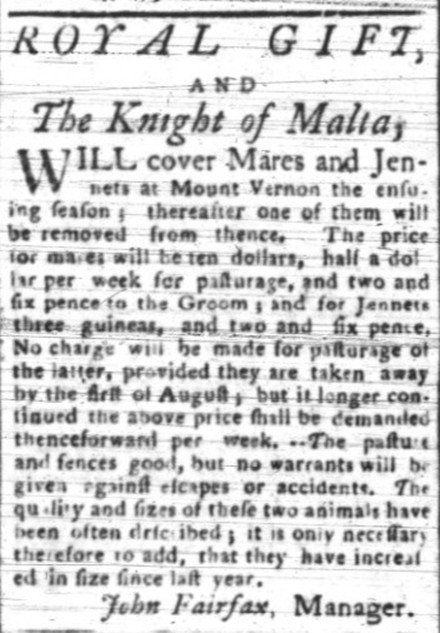
Finally, it appears that Hardiman was compensated for a small portion of his labor. Advertisements for the breeding services of Royal Gift and Knight of Malta specified that interested owners of mares needed to pay the groom a fee of two shillings and six pence for the care of their horses.21 Farm account books subsequently list numerous instances of Hardiman being paid for “Grooms fees” amounting to a total of 55 shillings and 11 pence over the course of nine years.22 While the earning of these wages would have benefited Hardiman and his family, this payment was a fraction of the wages he was denied as an enslaved man.
Hardiman likely fell ill in 1798 and consequently stopped working, as suggested by an invoice from Dr. James Craik for “Bleeding Peter Harden.”23 However, he recovered by the time of Washington’s death in 1799.24 As he was enslaved by the estate of John Parke Custis, he did not receive the freedom stipulated for those enslaved by George Washington. Peter Hardiman was ultimately inherited by John Parke Custis’ son George Washington Parke Custis, as were his wife and children after Martha Washington’s death in 1802.25 He continued to work as a groom for Custis at Arlington House, until he died sometime between 1811 and 1812.26
Although much is unknown about Hardiman’s life, we do know that he was essential to George Washington’s mule breeding business. As such, although Washington will always be known as the “Father of the American Mule,” Hardiman equally deserves recognition for the important role he played in bringing the mule to America.
Gabrielle McCoy, PhD
Notes:
1.“William Fitzhugh to George Washington, 2 November 1785,” Founders Online, National Archives.
2.“Ledger B, 1772-1793: pg. 272,” The Washington Papers; “Diary Entry. 18 February 1786,” Founders Online, National Archives.
3.“List of Slaves Belonging to George Washington and John Parke Custis, December 1771,” Founders Online, National Archives.
4.Custis, John Parke. Fairfax County, Virginia. Fairfax County Will Book D1 Inventories and Accounts, 1772-1783, pages 274-288, Family Search, accessed 8 July 2026.
5.“George Washington to David Stuart. 12 February 1787,”Founders Online, National Archives.
6. Ibid.
7.“Diary Entry. 6 April 1788,” Founders Online, National Archives; “Ledger B: 1722-1793. 10 April 1788.” Database of Mount Vernon’s Enslaved Community, Mount Vernon.
8.“George Augustine Washington to George Washington. 16 July 1790,”Founders Online, National Archives.
9.“George Washington to John Hoomes. 17 February 1791,” Founders Online, National Archives.
10.“George Washington to William Pearce. 22 May 1796,” Founders Online, National Archives; “George Washington to Howell Lewis. 4 August 1793,” Founders Online, National Archives.
11.“George Washington to William Pearce. 2 March 1794,” Founders Online, National Archives.
12.“George Washington to William Pearce. 13 March 1796,” Founders Online, National Archives.
13.“Memo for James Anderson and William Pearce. 5 November 1796,”Founders Online, National Archives.
14.“George Washington to David Stuart. 22 January 1788,” Founders Online, National Archives.
15.“Diary Entry. 18 February 1786,” Founders Online, National Archives; “Washington’s Slave List. June 1799,” Founders Online, National Archives.
16.“George Washington to David Stuart, 22 January 1788,” Founders Online, National Archives.
17. Numerous letters between George Washington and David Stuart discuss returning Peter Hardiman to David Stuart’s farm but ultimately deciding not to because of Peter Hardiman’s value as a stud manager. See: “George Washington to David Stuart. 12 February 1787,”Founders Online, National Archives; “David Stuart to George Washington. 15 February 1787,”Founders Online, National Archives; “George Washington to David Stuart. 18 January 1788,” Founders Online, National Archives; “George Washington to David Stuart. 22 January 1788,” Founders Online, National Archives.
18.“William Pearce to George Washington. 31 May 1795,” Founders Online, National Archives.
19.“George Washington to Anthony Whitting. 23 December 1792,”Founders Online, National Archives.
20.“Jean Le Mayeur to George Washington, 10 April 1786,” Founders Online, National Archives.
21.“Royal Gift and the Knight of Malta,” Virginia Herald and Fredericksburg Advertiser, 27 March 1788; “Royal Gift and the Knight of Malta,” Virginia Herald and Fredericksburg Advertiser, 2 April 1789; “Royal Gift,” Virginia Herald and Fredericksburg Advertiser, 1 April 1790; “Jacks,” Virginia Herald and Fredericksburg Advertiser, 14 April 1791.
22. “Manager Ledger of James Anderson. November 1798,” Database of Mount Vernon’s Enslaved Community, Mount Vernon; “Ledger B: 1722-1793: 6 July 1789, 10 August 1790, 9 September 1790, 1 June 1791, 17 November 1791, 24 November 1791, 8 December 1791, 5 May 1792, 24 September 1792, 15 May 1792, November 1798,” Database of Mount Vernon’s Enslaved Community, Mount Vernon.
23. “Invoice from Dr. James Craik. 25 September 1798,” Database of Mount Vernon’s Enslaved Community, Mount Vernon.
24.“Washington’s Slave List. June 1799,” Founders Online, National Archives.
25.“Division of Dower Slaves, 1802,” Peter Family Papers, The George Washington Presidential Library at Mount Vernon; “Appendix B: Division of Dower Slaves” in The Papers of Martha Washington, ed. Alicia K. Anderson, Jennifer E. Stertzer, et. al. University of Virginia Press, 2022.
26.“George Washington Parke Custis to James Hooe, 24 May [1812],” NYPL, George Washington Papers, Washington Family Papers, George Washington Parke Custis letters and writings.
Bibliography:
Anderson, Virginia DeJohn. Creatures of Empire: How Domestic Animals Transformed Early America. Oxford University Press, 2004.
Anderson, Virginia DeJohn. “Animals into the Wilderness: The Development of Livestock Husbandry in the Seventeenth-Century Chesapeake.” The William and Mary Quarterly 59, no. 2 (2002): 377–408.
Coe, Alexis. “George Washington Saw a Future for America: Mules.” 12 February 2020.
Thompson, Mary V. “The Only Unavoidable Subject of Regret”: George Washington, Slavery, and the Enslaved Community at Mount Vernon. Charlottesville and London: University of Virginia Press, 2019.
Schoelwer, Susan P., ed. Lives Bound Together: Slavery at George Washington's Mount Vernon. Mount Vernon, VA: Mount Vernon Ladies Association, 2016.
Yanes, José Emilio. “Royal Gift (Donkey.)” Digital Encyclopedia of George Washington.